747-400 and 747-8
An extended upper deck, then about 5.6 metres more, with two official seat counts kept apart
The hump was already there. Later versions used it. The National Air and Space Museum and Boeing then describe the 747-8 in figures that sit beside each other, and are not merged.
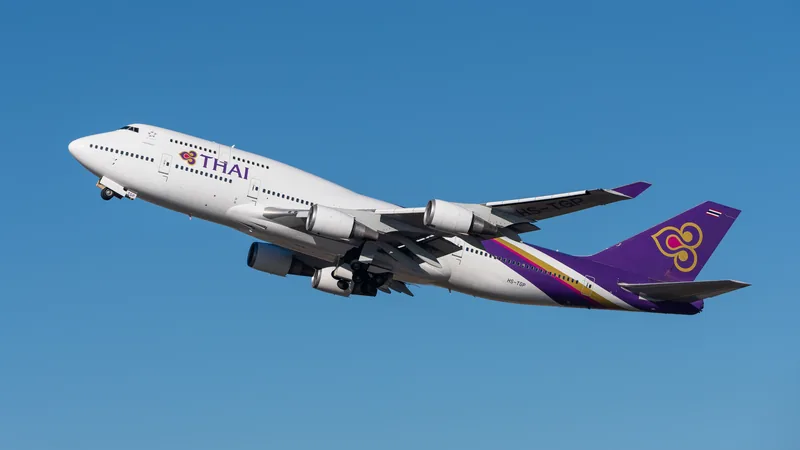
The 747-400
Once the flight deck had been put up behind the nose, later 747s could do something the first ones only hinted at: they could carry the hump farther back and put more people in it. Smithsonian magazine says so in one sentence: “Later versions of the 747 extended the hump farther back and made room for more first-class seats.” [source]
The National Air and Space Museum names the 747-400 directly. “The 747-400 can fly 416 passengers a range of 13,450 kilometers (8,360 miles). It features an extended upper deck and winglets.” [source] Those are the museum’s figures for that version, and this desk leaves them attached to the 747-400. They are not used as a substitute for the later 747-8 numbers on the same page.
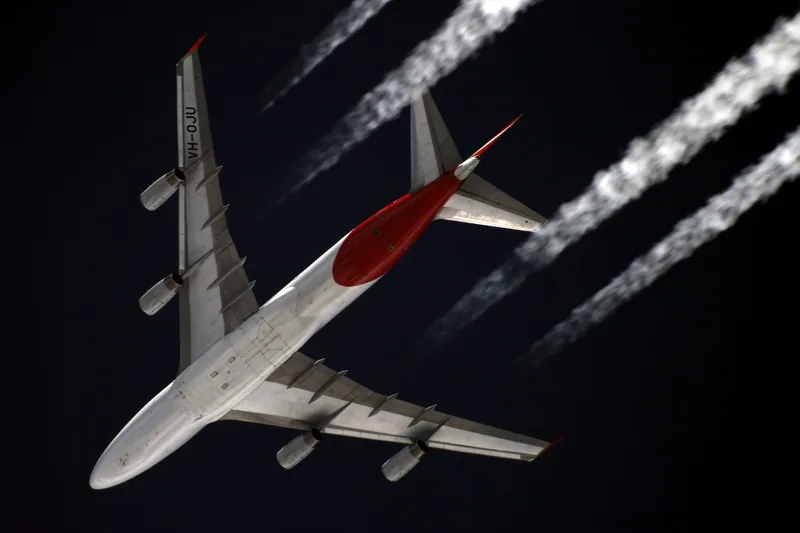
The photographs on this page are later 747-400s at work: Thai Airways International HS-TGP leaving Munich in February 2015, and Qantas VH-OJU photographed from the ground at Starbeyevo, near Moscow, in May 2010, flying at about 11,000 metres. They are pictures of the long-upper-deck aeroplane the museum is describing, not pictures of the first 1969 flight.
The 747-8, in two official desks
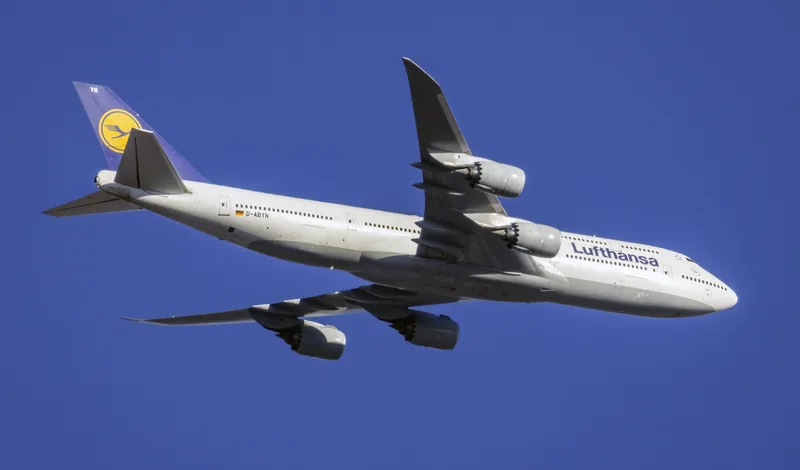
The same museum page then moves on one step. “The 747-8 adds about 5.6 meters (18 feet) of fuselage and has engines derived from the Boeing 787. It can carry about 467 people a distance of 14,800 kilometers (9,200 miles).” [source] “About 467 people” and “14,800 kilometers” are the museum’s wording, including the word “about.”
Boeing’s 747-8 Intercontinental overview, a 2018 StartupBoeing historical PDF saved for this site on 16 November 2026, describes the same later aeroplane in the company’s own figures. A seats comparison is labelled “747-8 (410 seats).” A range line, marked “MTOW, full passenger payload,” gives 7,730 nautical miles, or 14,310 kilometres. A length is given as 76.3 metres, or 250 feet 2 inches. Cruise is given as Mach 0.86. [source]
Those two desks do not say the same thing, and they are not in conflict that this site can settle. One is a museum sentence with “about 467 people” and 14,800 kilometres. The other is a Boeing overview with a 410-seat label and 14,310 kilometres at a stated payload condition. This page reports both, and does not offer an average, a winner, or a third invented figure.
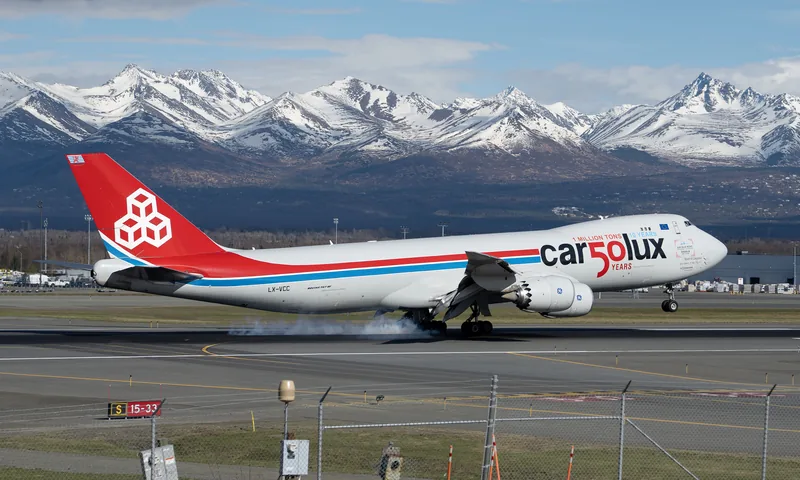
Boeing’s 747-8 commercial page also records a first flight for the freighter version: “The first Boeing 747-8 Freighter took to the skies on February 8, 2010,” on a route over western Washington, for “tests for basic handling qualities and engine performance,” and it “reached a cruising altitude of 17,000 feet (5,181 m).” [source] The Cargolux 747-8F landing at Anchorage in May 2026 is a later aeroplane of that family, not that first 747-8 Freighter, and not the final Atlas delivery of 2023.
The early “400-seat 747” of 1970, the 747-400’s 416 passengers, and the two official 747-8 counts, are four official ways of talking about seats. They belong to different versions, and in the last case to different publishers. The field notes keep that unblending in one place. The story of the last aeroplane in the line is on the last 747 page.
Enjoyed this desk on why the 747 has a hump, and the two official stories behind it?
No pop-ups. No intrusive advertising. Just interesting stuff. A little support helps the next aeroplanes.im site get built.