In the museum
Thirty-five feet to a frame station, and a prototype on Boeing Field
A magazine writer saw some 36 feet of fuselage on a gallery wall. The curator who put it there counted 35 feet, back to frame station 520. Both sentences are official, and they are not the same sentence.
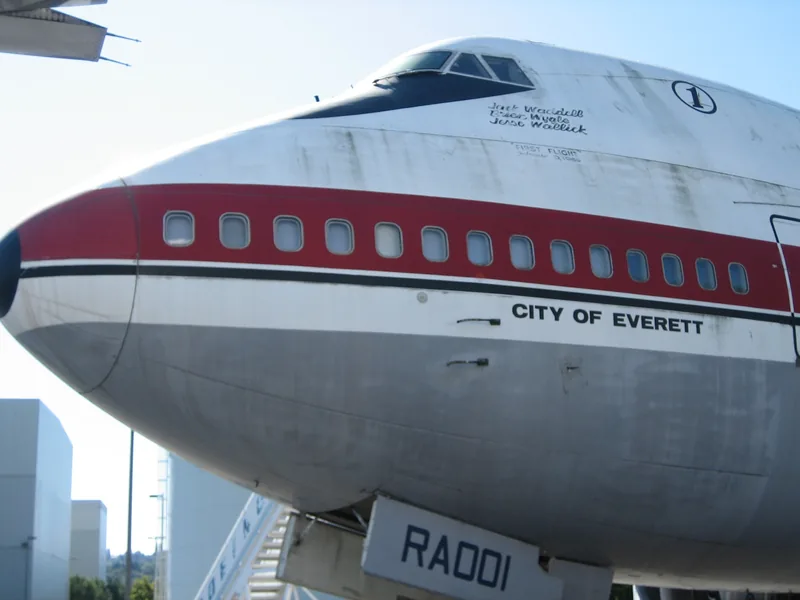
The preserved prototype
The 747 prototype sits, in a later photograph by Fawcett5 on 27 August 2005, at the Museum of Flight on Boeing Field. It is a good place to look at the shape whole: the raised cockpit, the length of the hump, the four engines. It is not a first-flight photograph, and this site does not read the painted lettering on the aeroplane as a source. The official first-flight date remains the San Diego Air and Space Museum catalogue caption, and Boeing’s matching caption, of 9 February 1969. [source] [source]
A nose in Washington
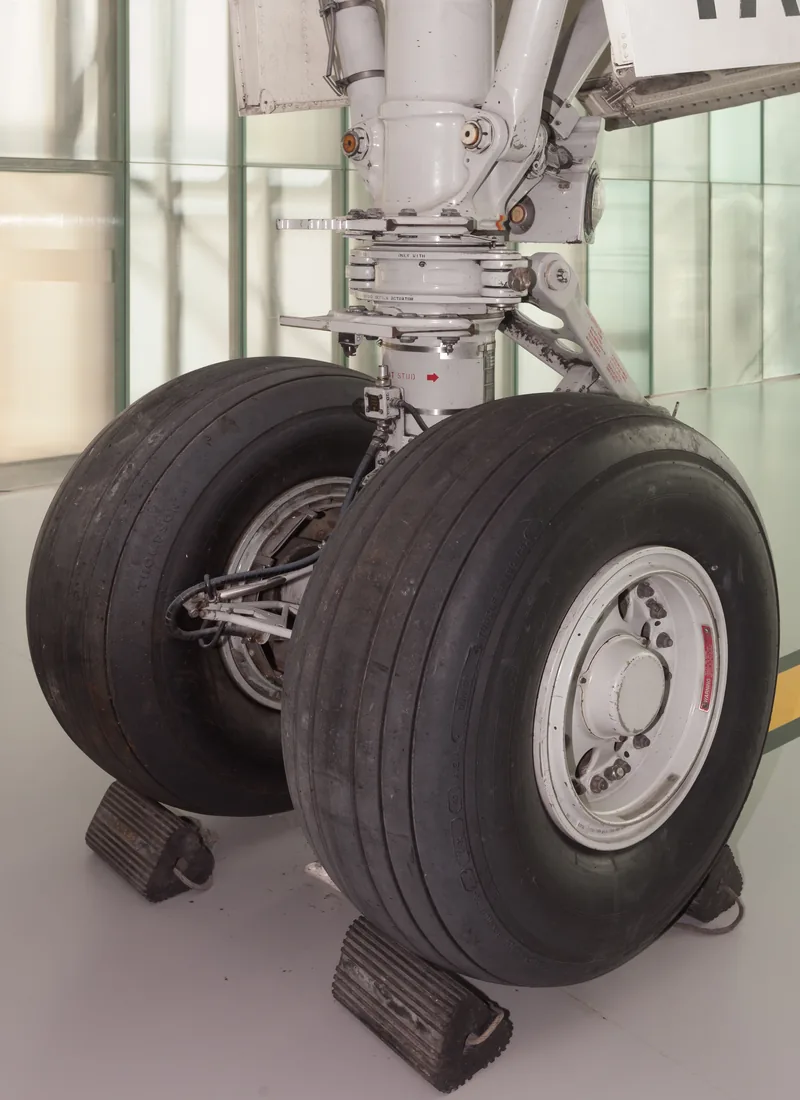
Another 747 was taken to pieces so that visitors could stand under a real nose indoors. In the National Air and Space Museum’s “Jumbo Jet” essay, the lead curator for America by Air writes that when visitors enter “the great expanse of the America by Air exhibition in the Hall of Air Transportation, they encounter the massive hull of a Boeing 747 forward fuselage.” He had wanted “to convey the scope and scale of modern jet travel.” A fabricated nose was the first plan. A real one arrived instead. [source]
The aeroplane chosen was N601US, “the first 747 built for Northwest,” “the first 747 to fly for an airline other than Pan Am,” and “the first 747 to open service across the Pacific.” “First flown in 1970” is written of that aeroplane, not of the type. Northwest “was looking for a good home for this aircraft because they were retiring all their early 747-151 series airplanes.” [source]
Five parts of the nose “were mutually reinforcing, but only if they connected at frame station 520.” “Armed with this information, we decided to take the entire nose back to frame 520, which meant taking a total of 35 feet, not 30.” Guard-Lee of Apopka, Florida, “carefully cut the nose from the airframe,” and in January 2007 “the Guard-Lee crew and Museum staff worked diligently to install the 747.” [source]
Thirty-six feet, and thirty-five
Bruce Hathaway, visiting as America by Air was “a new exhibition opening Saturday,” wrote in Smithsonian magazine that “Hanging on the wall is some 36 feet of the front fuselage of a 747; the entire airplane is 231 feet long.” [source] The curator’s essay says 35 feet, measured back to frame station 520. This desk keeps both official wordings and does not average them, and it does not treat the magazine’s 231-foot length as Boeing’s later 76.3-metre figure for the 747-8 Intercontinental. Those comparisons belong in the field notes.
Hathaway climbed “several flights of stairs” and looked into the cockpit, “smaller than my cubicle,” with “seating for the pilot, co-pilot and navigator” “really tight.” [source] The contrast is the same one the hump was built around: a vast aeroplane, and a flight deck that had to sit up out of the way of a door. The story of why that door exists is on the hump page. The story of N601US’s first flight date, and why it must not be used as the type’s first flight, is on the first flight page.
Enjoyed this desk on why the 747 has a hump, and the two official stories behind it?
No pop-ups. No intrusive advertising. Just interesting stuff. A little support helps the next aeroplanes.im site get built.