Discoveries
Things a 747 still does to a first look
A few official surprises, left as the sources wrote them: a cockpit that had to move, a 1970 first flight that is not the first flight, and a last aeroplane that was a freighter.
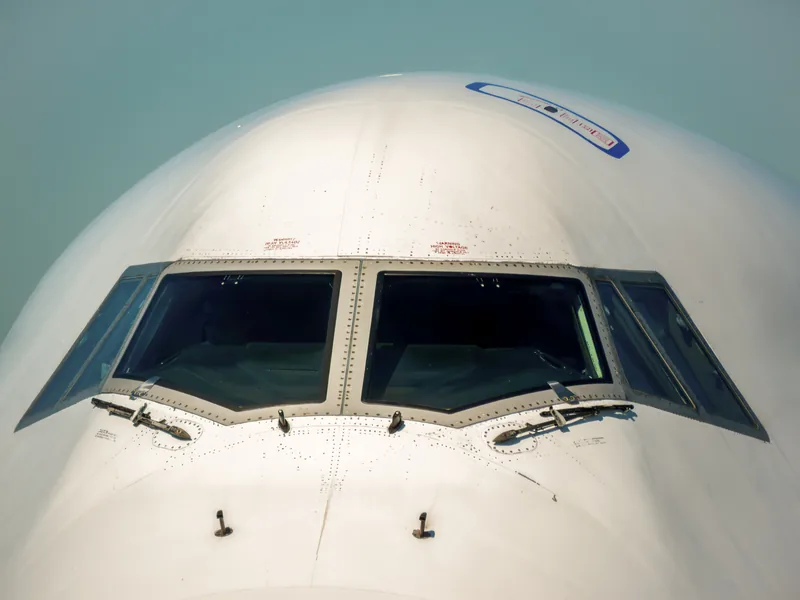
The hump is a cargo idea
The silhouette looks ornamental until you read the official reason. Juan Trippe wanted the 747 “easily convertible to a cargo plane,” with “a nose that could be opened and closed on a top hinge.” The cockpit could not sit in that hinge. It was “put up behind the nose,” and “there had to be a hump.” [source] The later first-class seats are a second official chapter, not the first cause. That still surprises people who have only ever boarded through a door in the side.
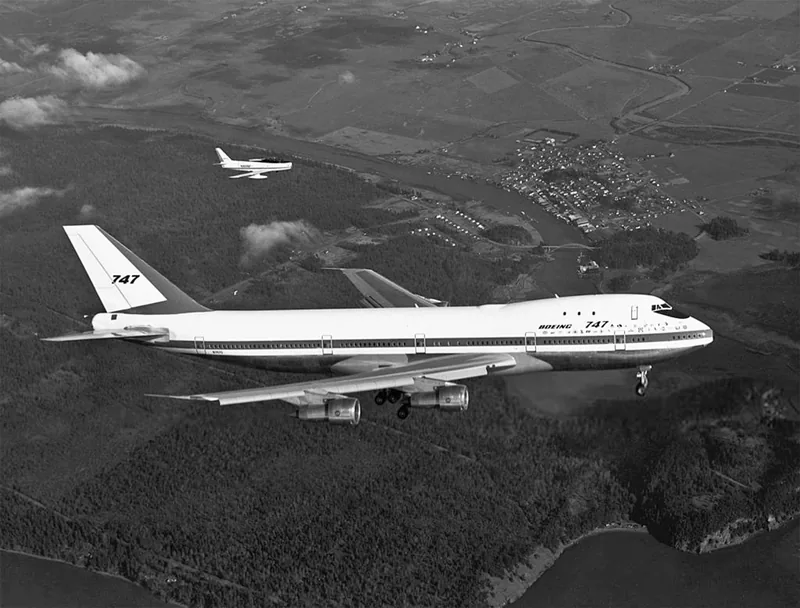
1969 and 1970 are both right, about different things
A catalogue photograph and a Boeing caption date the first flight to 9 February 1969. The National Air and Space Museum dates airline service to 1970, and, on another page, to January 1970. Boeing gives 22 January 1970, New York to London, for Pan Am. [source] [source] [source] [source] Meanwhile “First flown in 1970” is written of N601US, a particular Northwest aeroplane, not of the type. [source] The dates only become a muddle if they are blended.
The last one was a cargo aeroplane
When the line closed, on 31 January 2023, the aeroplane Boeing delivered was “this final 747-8 Freighter,” and it went to Atlas Air, “the largest operator of the 747.” The count was 1,574. The people nicknamed the “Incredibles,” who had built the first ones, were invited back to Everett. [source] The passenger jumbo is what most people picture. The last one off the line was built to carry freight.
Two official 747-8s, on two desks
The museum’s 747-8 “can carry about 467 people a distance of 14,800 kilometers.” Boeing’s 2018 Intercontinental overview labels “747-8 (410 seats)” and gives 14,310 kilometres at a stated payload condition, with a length of 76.3 metres. [source] [source] A reader who wants a single number will be disappointed, honestly. The interesting discovery is that both figures are official, and that they were written for different documents.
A quieter official honour sits on Boeing’s commercial page: in 1999 the United States Postal Service “unveiled the 747 Jumbo Jet stamp as part of its “Celebrate The Century,”” after “millions of Americans voted, singling out the 747 as one of the most significant technological achievements of the 20th century.” [source]
Enjoyed this desk on why the 747 has a hump, and the two official stories behind it?
No pop-ups. No intrusive advertising. Just interesting stuff. A little support helps the next aeroplanes.im site get built.