The first flight
9 February 1969 over Puget Sound, and then airline service in 1970
The catalogue photograph is a first flight. The museum’s service date is a later official sentence. Boeing, on a third desk, gives a calendar day and a route.
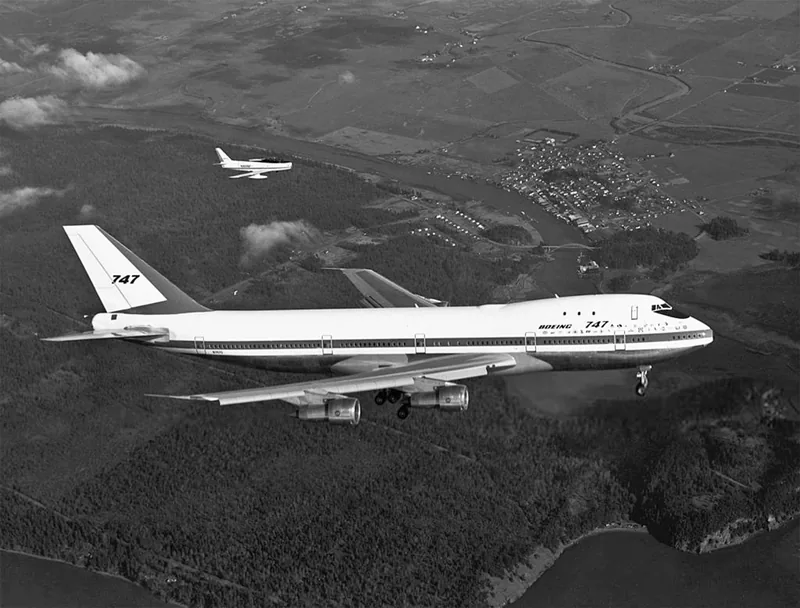
The first take-off
The photograph at the top of this page comes from the San Diego Air and Space Museum, catalog 00062326. Its caption is plain, and this desk uses that caption rather than the lettering later painted on a preserved prototype: “Boeing 747 with F-86 Chase Plane on its first flight on February 9, 1969 over the Puget Sound area of Washington State, USA.” [source]
Boeing’s 747-8 commercial page, in a caption kept from the copy saved on 16 November 2026, says the same date in the company’s own style: “The first 747 takes off on its first flight Feb. 9, 1969.” Another caption on that page puts the public debut at “the Paris Air Show in 1969,” and the rollout earlier still: “The first 747 rolls out of the Everett factory on Sept. 30, 1968.” [source] The journey of the programme, in Boeing’s later delivery release, “began in 1967.” [source]
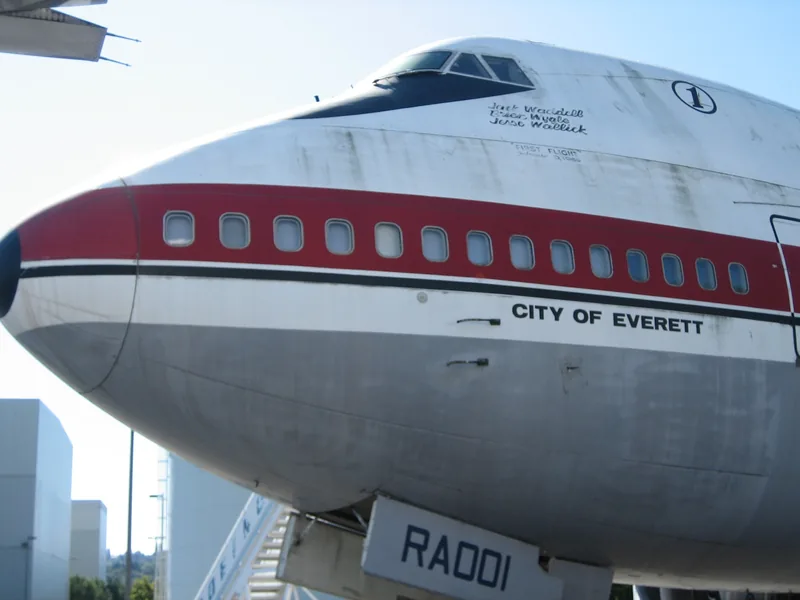
The preserved prototype, photographed here much later at the Museum of Flight on Boeing Field, is a lovely thing to stand beside. It is not the first-flight photograph, and the painted lettering on it is not treated as a source. The catalogue still, and Boeing’s caption, are the official dates this page uses for the first take-off.
When it entered service
Airline service is told three official ways, and they are close without being identical. The National Air and Space Museum’s Evolution page says the 747 “revolutionized long-distance air travel when it entered service in 1970.” The same museum’s Pan American Airways page says “the first Boeing 747 entered service in January 1970,” and, in another sentence on that page, again “entered service in 1970.” [source] [source]
Boeing’s 747-8 page gives a day and a route: “On Jan. 22, 1970, the first 747 entered service on Pan Am Airlines’ New York–London route.” [source] This desk reports all three wordings and does not flatten them into a single invented phrase. “January 1970,” “1970,” and “Jan. 22, 1970” on the New York–London route are the official sentences as they stand.
What the 747 was for, in the museum’s telling, is not in doubt. It was “Designed originally for Pan American to replace the 707,” “Carrying more than twice the passengers than the 189-seat 707.” The Evolution page calls it “the 400-seat 747,” which “offered dramatically lower seat-mile costs and therefore much greater efficiency.” The Pan Am page says the same 400 passengers, “and later versions even more,” and “far lower seat-mile costs.” [source] [source]
A 1970 first flight that is not the type’s first flight
There is one more 1970 date, and it belongs to a particular aeroplane. In the museum’s “Jumbo Jet” essay, the nose now hanging in America by Air is N601US, “the first 747 built for Northwest,” “the first 747 to fly for an airline other than Pan Am,” and “the first 747 to open service across the Pacific.” Of that aeroplane the curator writes: “First flown in 1970, the aircraft—number N601US—has a remarkable history.” [source] That “first flown in 1970” is N601US, not the type. The type had already flown, over Puget Sound, in February 1969.
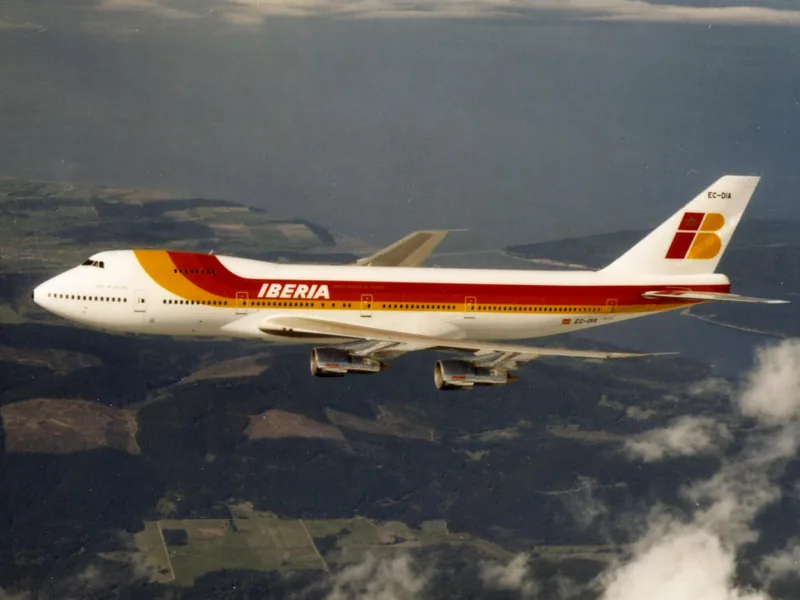
Iberia’s EC-DIA, photographed in April 1980, is simply a later airline 747, a reminder that the shape had already settled into ordinary service by then. The story of how the later versions grew an upper deck, and how the last of 1,574 left Everett, continues on the versions and last 747 pages.
Enjoyed this desk on why the 747 has a hump, and the two official stories behind it?
No pop-ups. No intrusive advertising. Just interesting stuff. A little support helps the next aeroplanes.im site get built.