Other jobs
A nose that opens, a shuttle on the back, and a freighter that outlived the passenger line
The hump exists because someone wanted a cargo aeroplane. The later pictures still show that wish at work, and one NASA still shows another job entirely.
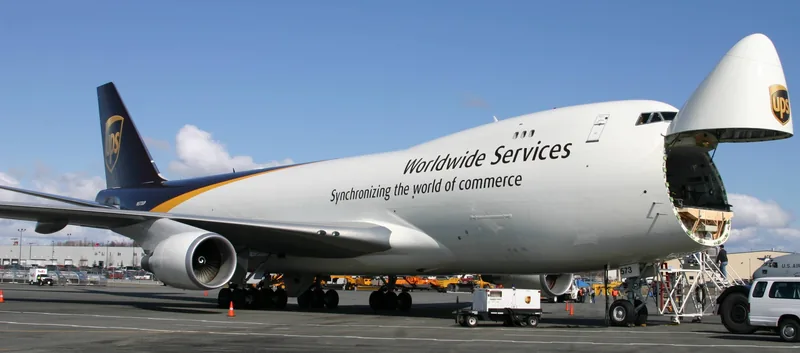
The hinge at the front
Juan Trippe’s request, in Smithsonian magazine’s 2007 telling, was not for a pretty silhouette. He wanted the 747 “easily convertible to a cargo plane,” and that “meant a nose that could be opened and closed on a top hinge.” [source] Decades later, a UPS 747-400 photographed by Frank Kovalchek on 10 May 2008 still demonstrates the arrangement: the nose is up, the cargo deck is a tunnel, and the cockpit sits above the hinge, exactly where Hathaway said it had to go.
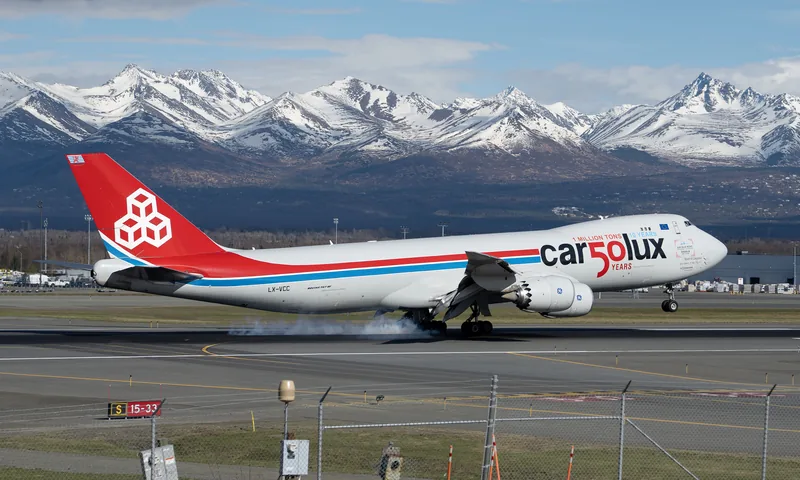
The last aeroplane in the production line was itself a freighter. Boeing’s 31 January 2023 release calls it “this final 747-8 Freighter,” delivered to Atlas Air. [source] The first 747-8 Freighter, on Boeing’s commercial page, “took to the skies on February 8, 2010.” [source] A Cargolux 747-8F landing at Anchorage in May 2026 is later still: same family, not the same aeroplane as either of those official firsts or lasts.
Atlas Air’s own official story, in that delivery release, begins with cargo. The company “was founded over 30 years ago with a single 747-200 converted freighter,” and had since operated “nearly every fleet type of the 747, including the Dreamlifter, Boeing’s 747 Large Cargo Freighter, for the transport of 787 Dreamliner parts.” [source] The Dreamlifter is quoted here as Boeing and Atlas name it, not as a separate history this desk has not sourced beyond that sentence.
A shuttle on the back
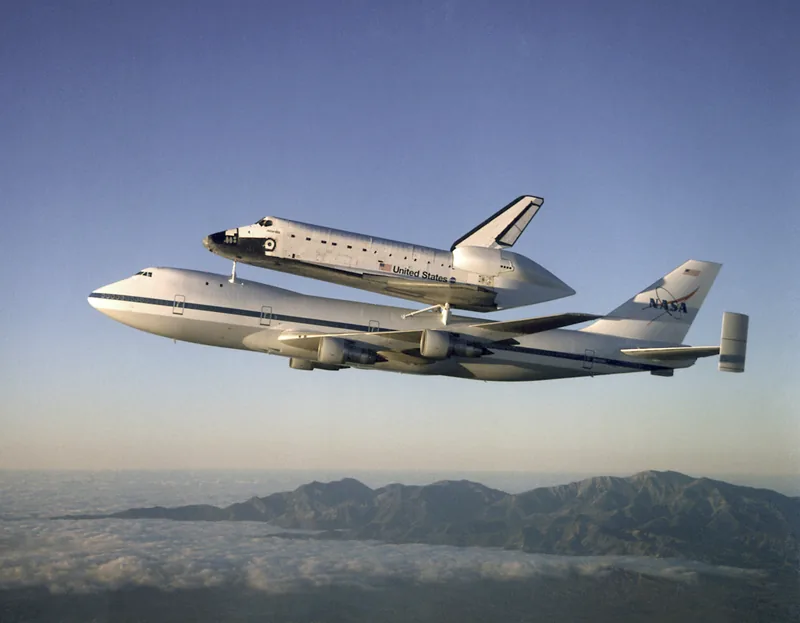
One photograph on this site shows another job the type was given. In September 1998, NASA’s Carla Thomas photographed Space Shuttle Atlantis on a Shuttle Carrier Aircraft. The still is public domain, and it is used here as a picture of that arrangement: a 747 carrying a Shuttle on its back. This desk does not, from that single still, write a history of the Shuttle programme, or invent first-flight dates, flight counts, or fleet numbers for the carrier aircraft. The photograph is the source, and the caption stays with what the photograph shows.
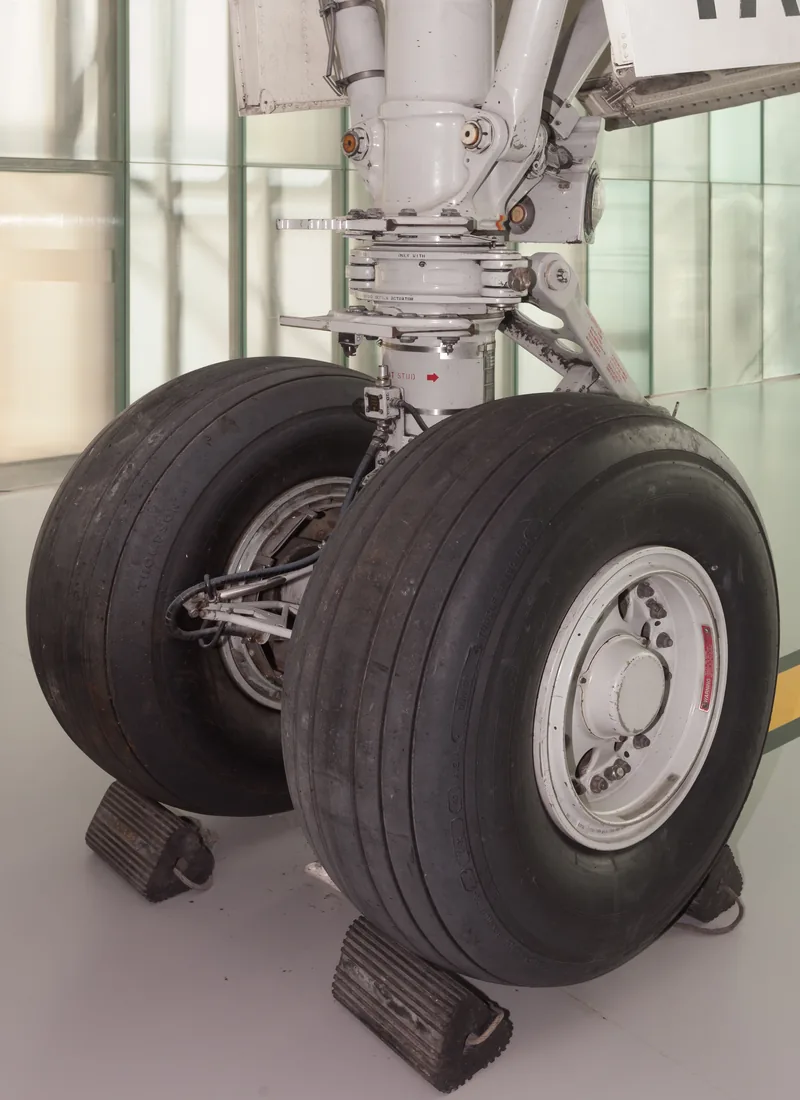
Even on the ground the aeroplane is a set of answers to size. Luis Miguel Bugallo Sánchez’s still of a 747 undercarriage at MUNCYT in A Coruña, taken on 17 April 2017, is a close view of the gear Hathaway stood beside when the scale of the aeroplane first impressed him. The official stories of why the nose opens, and when the last freighter left Everett, remain the spine of this desk. The pictures are what those stories look like when someone opens a hangar door, or looks up from a museum floor.
Enjoyed this desk on why the 747 has a hump, and the two official stories behind it?
No pop-ups. No intrusive advertising. Just interesting stuff. A little support helps the next aeroplanes.im site get built.